
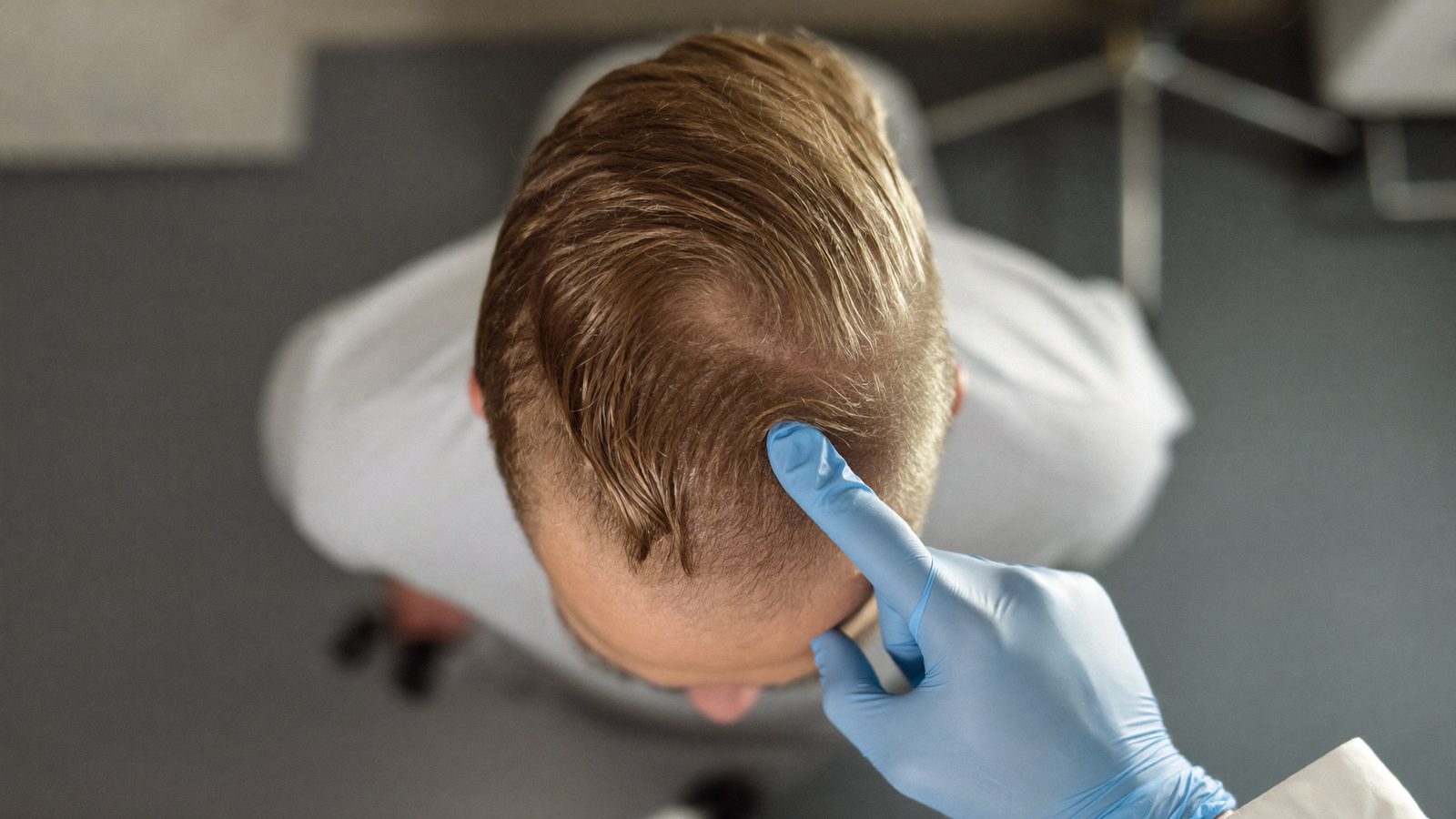
People often talk about a hair transplant as if it were one procedure, but the scalp is really several different zones. FUE for the crown is planned very differently from FUE for the hairline, and the temples need their own approach again. Each area has its own growth direction, its own density target and its own risks, and a good plan treats them separately while making the final result look like one continuous head of hair.
This guide walks through how the team at Nova Medical NYC approaches the hairline, the temples and the crown with FUE hair transplantation, why the crown usually needs more grafts than people expect, and how the zones are prioritized when your donor supply is limited.
Why Each Zone Needs Its Own Plan
Hair does not grow in the same direction everywhere. At the front it points forward. At the temples it sweeps downward and backward. At the crown it grows in a spiral, or whorl, that radiates outward from a central point. A transplant that ignores those patterns looks wrong even when the grafts grow well.
The zones also matter differently for appearance. The hairline frames the face and is seen by everyone you meet. The crown is mostly seen from above and behind, often by you in a mirror or in photos. That difference shapes how grafts are spent.
| Zone | Growth pattern | Main goal | Typical priority |
| Hairline and front third | Forward, low angle | Natural edge and density that frames the face | First |
| Temples and temple points | Down and back, very flat | Restore the corners and side framing | With the hairline |
| Mid-scalp | Forward and outward | Bridge front and back, styling volume | Second |
| Crown (vertex) | Spiral whorl | Reduce the see-through spot | Last, or a separate session |
The Hairline: Precision Over Volume
Hairline work uses fewer grafts per square centimeter than people assume, but each graft has to be placed with great care. The leading edge is built from single-hair grafts set at a very low angle, with small irregularities so it does not look drawn on. Two- and three-hair grafts sit behind the edge to create density. Most hairline restorations focus between 1,000 and 2,500 grafts on the front of the scalp, depending on how far back the recession goes.
Because the hairline is the most visible part of the result, it is also where design mistakes are most obvious. Our article on natural-looking hairline design explains how height, shape and angle are chosen.
The Temples and Temple Points
The temples are often the first area to recede, and they are one of the trickiest to restore. Hair here grows almost flat against the skin, sweeping down toward the ears. Grafts must follow that direction at a very acute angle or they will stick out and look unnatural.
There are two distinct parts. The temporal recession is the corner of the hairline above each outer eyebrow. The temple points are the small triangles of hair in front of the ears that point toward the eyes. Temple points are often overlooked but make a big difference to how the face is framed, especially in older men whose sides have thinned. Fine single-hair grafts are used for both, and the work is usually planned together with the hairline.
Design caution: filling the temple corners completely creates a straight, juvenile hairline that rarely suits an adult face. A natural result keeps a gentle recession at the corners.
FUE for the Crown: Why It Is Different
The crown, or vertex, is the area at the top and back of the head. It is a common place for thinning and often bothers patients because it shows in photos and under overhead lights. FUE for the crown is very achievable, but it comes with three challenges that surgeons plan around.
The whorl. Hair at the crown grows in a spiral from a central point. Grafts have to recreate that swirl, changing angle and direction around the circle, or the area will look flat or messy.
The size of the area. The crown is a circle, and the area of a circle grows quickly as its radius increases. A crown that looks like a modest spot can need 1,000 to 2,000 grafts or more for convincing coverage, which is often more than the same patient needs for the hairline.
Progression. Crown loss tends to keep expanding outward. If only the center is filled and the surrounding hair later thins, a ring of thinning can appear around the transplanted area. For this reason the crown is often treated after the front, sometimes in a second session, and almost always with medical treatment to protect the native hair around it.
How Grafts Are Prioritized When Donor Supply Is Limited
Everyone has a finite number of grafts that can be safely harvested over a lifetime, typically somewhere between 6,000 and 8,000 by FUE, with wide individual variation. When loss is extensive, the plan has to decide where those grafts do the most good.
Most surgeons, including our team, put the front first. A restored hairline and front third changes how your face looks in every conversation, while a thinner crown is less noticeable in daily life and can be helped with styling and medication. That does not mean the crown is ignored: when the donor area allows it, front and crown can be treated in one long session or in two stages. Our guide on how many grafts you need explains how this budget is worked out.
Treating the Crown Without Surgery First
Crown thinning often responds well to medical treatment, especially in its early stages. Prescription medication can slow or partly reverse thinning in many men, and PRP treatment may strengthen hair that is still present. Many patients start with these options, see how much the crown improves, then decide whether grafts are needed. Combining both often gives the fullest result.
Recovery Differences by Zone
Healing is similar wherever grafts are placed, but the experience differs. Hairline and temple grafts are visible to others for the first week to ten days, and swelling of the forehead is more likely after frontal work. Crown grafts are hidden from your own view, which makes them easier to forget about but also easier to bump. Sleeping position matters more after crown work, and you need to be careful with headrests, hats and car seats for the first ten days. For a full timeline, read our day-by-day recovery guide.
Growth timing is the same for every zone, though crowns are often slower to show a full result. Expect visible change around six months and the final result at 12 months for the hairline and up to 18 months for the crown.
Real-World Scenarios
A 32-year-old with temple recession and a stable crown. The plan focuses on the hairline and temples, often 1,500 to 2,200 grafts, with medication to keep the crown stable. The crown is monitored rather than treated.
A 45-year-old with frontal loss and a thinning crown. If donor density allows, the front third and hairline are restored first in one session. The crown is treated in a second session about a year later, once the first result has matured and the remaining donor supply is clear.
A 55-year-old with grey hair and a large crown. Grey hair hides thinning well, so a moderate number of grafts spread across the front and top can create a full appearance. The crown may receive lighter coverage, with styling doing the rest.
Planning Your Procedure
At your free assessment, the team maps each zone separately, measures donor density and discusses which areas matter most to you. You receive a written plan showing how many grafts go to the hairline, the temples, the mid-scalp and the crown, along with the price. You can see how different zones look after treatment in our before and after gallery.
Plan Each Zone With Our Team
A free assessment with Dr. Val Prokurat, MD maps your hairline, temples and crown separately and gives you a written graft plan and price for each area.