
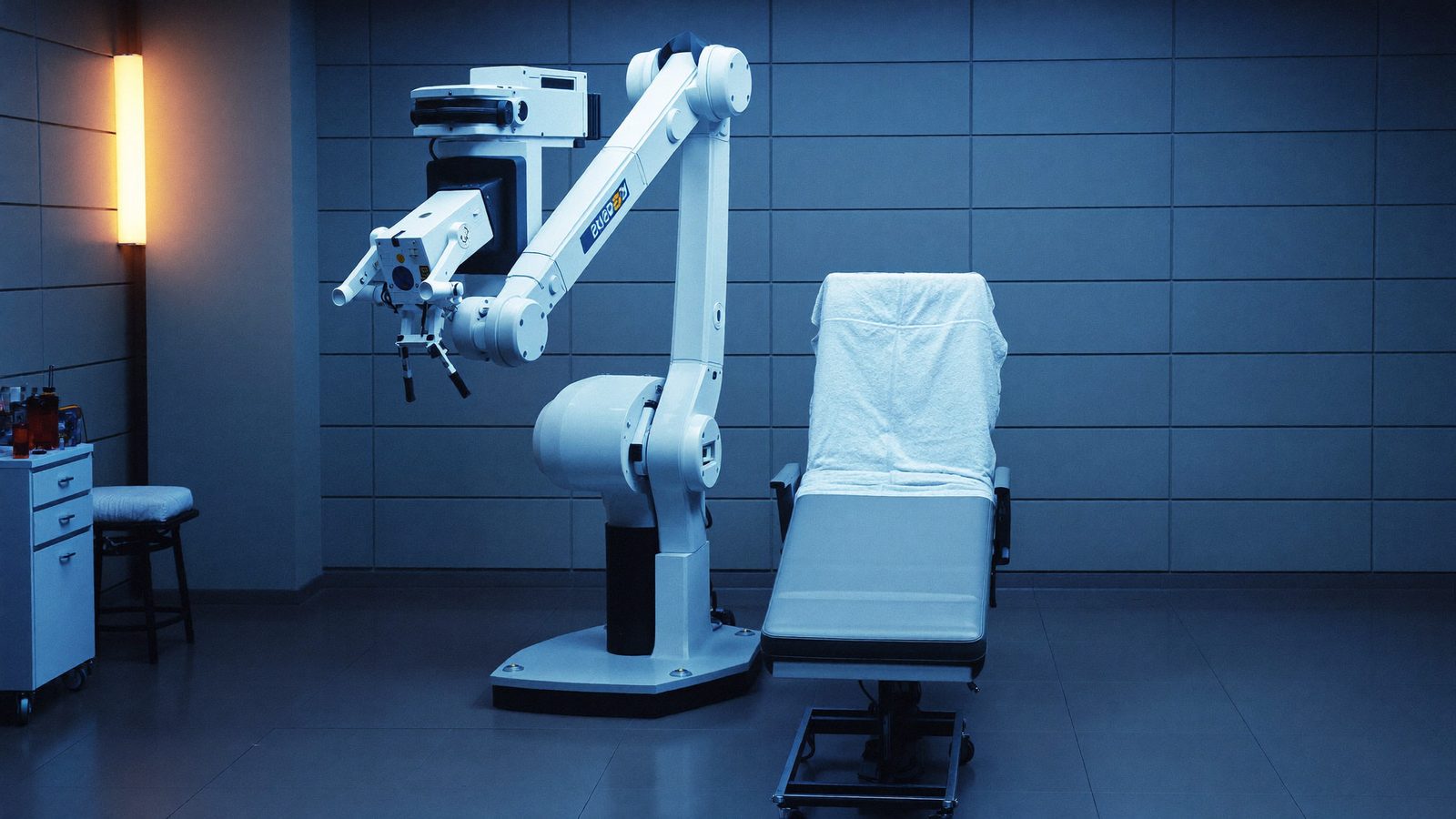
ARTAS is one of the best-known names in hair restoration technology. Marketed as a robotic hair transplant, it uses cameras and a robotic arm to help harvest follicles, and many patients ask whether a robot will give them a better result than a human team. It is a fair question, and the honest answer is that ARTAS is a capable tool with real strengths and real limits, and that the planning and judgment around any extraction matter more than the machine itself.
This guide explains how ARTAS works, what it automates and what it does not, where it struggles, and why many patients choose manual FUE instead. At Nova Medical NYC, our team uses manual FUE hair transplantation with precise motorized handheld tools, overseen by Dr. Val Prokurat, MD.
What ARTAS Is
ARTAS is a robotic system for follicular unit extraction, the harvesting stage of an FUE procedure. A camera system maps the donor area and identifies follicular units. The robotic arm then aligns a punch with selected follicles and scores around them. Depending on the system and setup, the grafts are then removed and placed by the clinical team, and some versions can also assist with making recipient sites.
In other words, ARTAS is a form of FUE, not a different procedure. The grafts are the same follicular units used in any FUE transplant, and they grow on the same timeline.
What the Robot Does Well
- Consistency. A robot does not tire, so the scoring motion is uniform across thousands of grafts.
- Mapping. The camera system can help spread extractions evenly across the donor area.
- Speed of extraction on suitable hair. On straight, dark hair with good contrast against the scalp, the system can work efficiently.
Where ARTAS Struggles
The system relies on reading what it can see at the surface of the scalp, and that creates limits in several situations:
- Curly and Afro-textured hair. In curly hair the follicle curves under the skin. A machine that aligns to the visible angle at the surface is more likely to cut through a curved follicle. Experienced manual teams adjust punch type and depth graft by graft.
- Grey, white or light hair. Low contrast between hair and scalp makes it harder for the camera to identify follicles accurately.
- Shaving requirements. Robotic harvesting typically requires the donor area to be trimmed short, which rules out unshaven procedures.
- Areas outside reach. Some donor regions and some head positions are harder for the robot to access.
- The rest of the procedure. The robot does not design your hairline, decide how many grafts your donor area can safely give or place grafts with artistic judgment.
Our guide to hair transplants for every hair type explains why curl and color change extraction so much.
ARTAS vs. Manual FUE Side by Side
| Factor | ARTAS robotic FUE | Manual FUE (Nova Medical approach) |
| Extraction | Robot-guided scoring of follicles | Motorized handheld punches guided by the team |
| Adapts to curly or grey hair | Limited | Adjusted graft by graft |
| Unshaven option | Generally not available | Available for suitable cases |
| Hairline design | Done by the clinical team | Done by the clinical team, approved by the physician |
| Graft placement | Usually manual | Manual, sorted by hair count and angle |
| Cost | Often priced higher to cover the equipment | $3.99 to $7.99 per graft at our clinic |
Does a Robot Give Better Results?
There is no strong evidence that robotic extraction produces better final results than experienced manual FUE across all patients. Results depend mostly on hairline design, graft handling, storage, placement and aftercare, and those are human steps. A robot can make one part of the process more uniform, but it cannot compensate for poor planning or rushed placement. Conversely, an experienced manual team can match or exceed robotic consistency while adapting to each patient's hair.
Bottom line: ask about the team and the plan, not the machine. The questions that predict a good result are about donor management, graft storage, placement and follow-up, which are covered in the Nova Medical FUE Protocol.
Why We Choose Manual FUE
At our Upper East Side clinic, we rely on skilled manual extraction with motorized handheld tools rather than robotic systems. Manual extraction lets the team read each follicle's angle and curve, change punch size or depth when needed, treat curly, grey and fine hair with the same care, and offer unshaven or partially shaved procedures when they suit the patient. In our experience it delivers excellent graft quality at a fair price, without passing on the cost of expensive equipment.
Cost Considerations
Robotic systems are expensive to buy and maintain, and clinics often build that into the price per graft. At Nova Medical NYC, pricing runs from $3.99 to $7.99 per graft, most procedures fall between $4,000 and $15,000, there are no session fees and 0% financing is available for the first 12 months. See the hair transplant cost page for detail.
Questions to Ask a Clinic Offering ARTAS
- Is my hair type, color and curl suitable for robotic extraction, and what transection rate do you expect for my hair?
- Who designs my hairline, and who places the grafts?
- How many grafts will be harvested, and how much donor reserve will remain?
- Does the robot also make recipient sites, and if so, how are angles adjusted for my hairline?
- Is the price higher than your manual FUE price, and why?
- Can I see results at 12 months for patients similar to me?
Real-World Scenarios
A patient with straight, dark hair and a dense donor area. Robotic extraction may work efficiently, but a skilled manual team can deliver an equally strong result, often at a lower price and with the option of an unshaven procedure.
A patient with tightly curled hair. Manual extraction is usually the better choice, because the team can read the curve of each follicle below the skin and adjust punch depth and size to avoid damaging grafts.
A patient with mostly grey hair. Low contrast makes robotic targeting harder. A manual team using magnification and good lighting can work accurately, and grey hair often needs fewer grafts for a full look.
What Matters on the Day
Whatever method is used, the day follows the same essential steps: hairline design and approval, donor preparation and local anesthetic, extraction, graft sorting and chilled storage, recipient site creation and placement. Graft survival depends on how gently grafts are handled, how quickly they are placed and how well they are kept cool and hydrated in between. These are the steps worth asking about, because they shape your result more than whether extraction is guided by a robot or by an experienced pair of hands.
Common Myths About Robotic Transplants
"The robot does the whole surgery." Robotic systems mainly assist with extraction. Hairline design, graft preparation and usually placement remain human steps.
"A robot means no scarring." Robotic FUE leaves the same small round scars as manual FUE, because the same type of punch extraction is used.
"Robotic means faster recovery." Recovery depends on the FUE technique and the size of the procedure, not on whether extraction was robot-assisted.
"Robotic results are more natural." Naturalness comes from design and placement. A well-designed manual procedure looks just as natural as a robotic one.
Who Might Still Prefer a Robotic Approach
Some patients feel more comfortable knowing a machine is involved, and for people with straight, dark hair, good contrast against the scalp and a dense donor area, a robotic procedure in an experienced clinic can produce a good result. If you are drawn to ARTAS, the important thing is to judge the clinic by the same standards you would apply anywhere: a physician who designs and oversees the plan, honest graft numbers, careful graft storage and strong results at 12 months for patients like you.
If your hair is curly, grey, light or fine, or if you want an unshaven procedure, a hands-on manual team will usually give you more flexibility. Either way, you are choosing a team, not a machine.
Other Devices Compared
ARTAS is one of several branded devices. NeoGraft and SmartGraft are automated FUE devices that use motorized punches with suction. Read our comparisons of NeoGraft vs. manual FUE and SmartGraft vs. manual FUE, or start with our overview of which hair transplant technique is right for you.
Compare Robotic and Manual FUE for Your Hair
A free assessment with Dr. Val Prokurat, MD looks at your hair type and donor area and explains why manual FUE suits your case, with a written graft plan and price.