
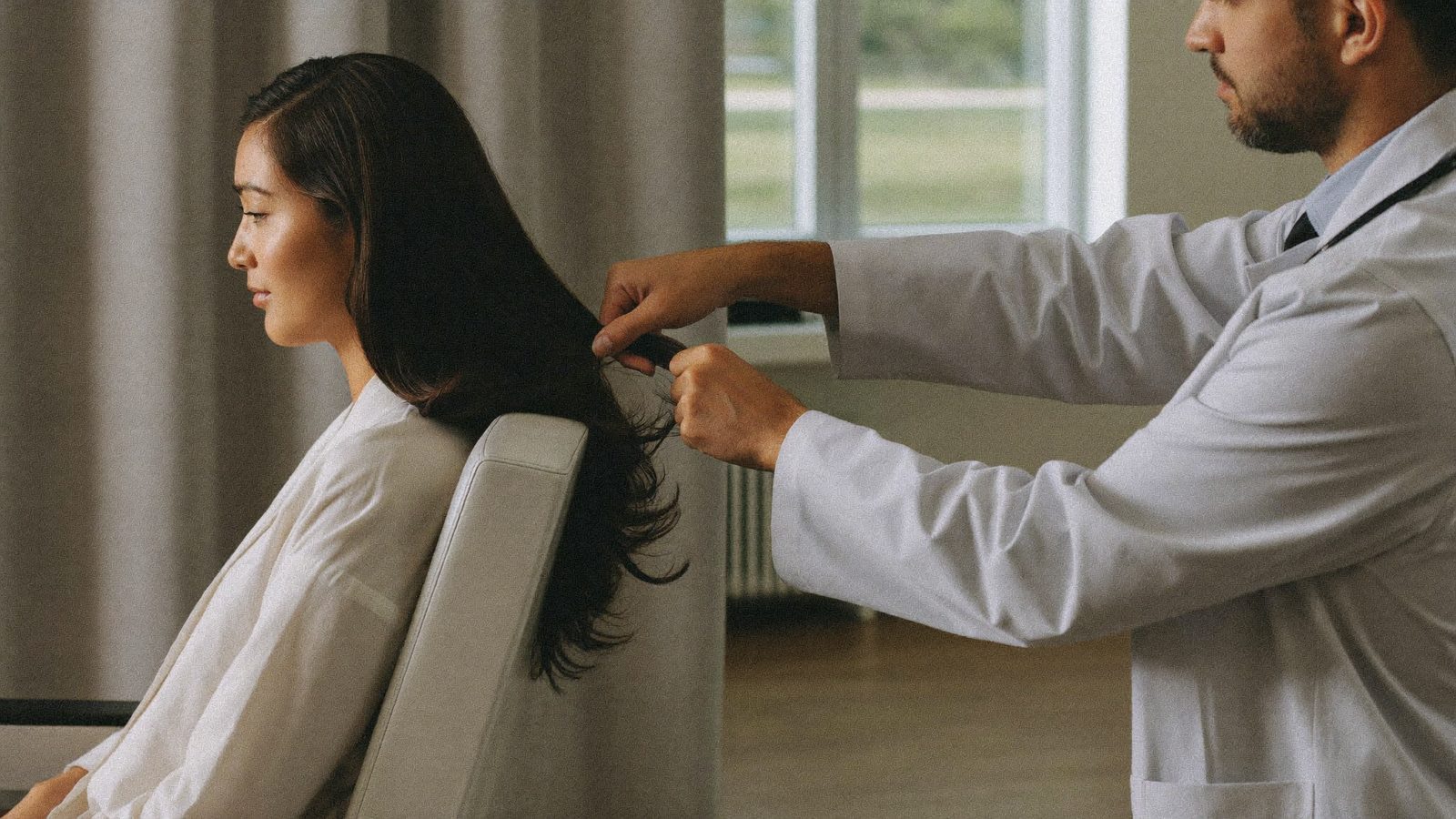
For many people, the hardest part of planning a hair transplant is not the procedure itself but the shaved head that usually comes with it. A non-shave hair transplant, and its close cousin the partially shaved procedure, offer a way to restore hair without the obvious look of a fresh buzz cut. They are especially popular with women, people in client-facing jobs and anyone who wears their hair long.
These options are real and effective, but they are not right for everyone. This guide explains how unshaven and partially shaved FUE work, who makes a good candidate, how many grafts they allow and how cost and recovery compare. At Nova Medical NYC, the right option is decided after Dr. Val Prokurat, MD reviews your hair, donor area and goals.
Why Most Hair Transplants Involve Shaving
In a standard FUE hair transplant, the donor area at the back and sides is trimmed to about one millimeter. Short hair lets the team see the exit angle of every follicle, choose the best grafts and extract them cleanly with less risk of damage. The recipient area is often trimmed too, so recipient sites can be made at precise angles between existing hairs.
Shaving makes the procedure faster and more efficient, and it usually allows the largest number of grafts in one day. The downside is cosmetic: for a week or two it is obvious that something has been done, and some people simply cannot take that time off or change their look.
How a Non-Shave Hair Transplant Works
In a fully unshaven procedure, the donor hair is left long. The team works through the hair, lifting it and trimming only the individual follicles to be extracted, one at a time, often just below the surface so the long hair around them falls back over the extraction sites. In the recipient area, sites are made between existing hairs without trimming them.
Because the long hair covers both donor and recipient areas, the procedure can be very difficult to detect once healing begins. Some techniques even allow transplanting grafts with longer hair still attached, which gives an immediate preview of the hairline, although those hairs usually shed in the following weeks like any transplanted hair.
Partially Shaved Options
A middle ground is the partial shave. Instead of trimming the whole donor area, the team shaves one or more narrow strips or windows that sit under longer hair. When you let your hair down, the shaved strips are hidden. This keeps much of the efficiency of a standard procedure while keeping it discreet.
| Option | How visible right after | Typical graft range per day | Relative cost |
| Full shave FUE | Obvious short trim for 1 to 2 weeks | Up to about 4,000 | Standard |
| Partial shave (hidden strips) | Hidden under longer hair | Up to about 2,500 | Moderately higher |
| Fully unshaven | Very hard to detect | Usually up to about 1,500 | Highest per graft |
Who Is a Good Candidate
A non-shave or partially shaved approach tends to work well when:
- The area to treat is small to moderate, such as a hairline refinement, temple correction, filling a part line or adding density to an existing transplant.
- You have enough length to hide work, usually at least two to three inches on top and at the back.
- You are a woman with diffuse thinning or a widening part, where shaving would be a major disruption. Our female hair transplant page explains how these cases are planned.
- Your work or public profile makes downtime difficult. Patients who need complete discretion often ask about our celebrity hair transplant package.
It is usually a poor fit when a large number of grafts is needed, for example extensive Norwood 5 to 7 loss, because the slower technique limits how much can be moved in one day. Very curly or coarse hair can also make unshaven extraction harder, since the team cannot see the follicle's direction below the skin as easily. Our guide to hair transplants for every hair type covers these differences.
The Trade-Offs
Every advantage of an unshaven procedure has a cost elsewhere, and it is worth knowing them before you decide.
Time. Working through long hair is slow. A procedure that would take a few hours shaved can take a full day unshaven.
Graft numbers. Because of the time involved, fewer grafts can be moved in one session. Larger restorations may need two sessions or a hybrid approach.
Price. More team time per graft means a higher price per graft. At Nova Medical NYC, pricing runs from $3.99 to $7.99 per graft depending on technique and complexity, and unshaven work sits toward the upper end. Most procedures still total between $4,000 and $15,000, with 0% financing for the first 12 months and no session fees. See our hair transplant cost page for detail.
Precision. In the hands of an experienced team, results are as good as a shaved procedure, but the margin for error is smaller, which is why this approach depends heavily on the skill of the team.
Honest advice: if a shaved procedure would let you move all the grafts you need in one session, it is often worth arranging a week or two of discretion rather than splitting the work across two unshaven sessions.
Recovery After an Unshaven Procedure
Recovery follows the same biological timeline as any FUE: grafts are secure after about ten days, the transplanted hairs usually shed between weeks two and six, new growth starts around month three or four, and the final result appears around month twelve. The difference is how it looks. Small scabs are hidden by the surrounding hair, and many patients return to work within a few days without anyone noticing.
You still need to follow aftercare carefully: gentle washing from day two or three, avoiding friction on the recipient area and keeping hair products away from the grafts until cleared. Our guide to returning to work and the gym covers what to expect in the first weeks, and the hair transplant recovery page sets out aftercare in full.
A Typical Unshaven Procedure Day
The day begins with planning: the recipient area is mapped and, for hairline work, the new edge is drawn. The donor area is numbed with local anesthetic and the team begins working through the long hair, isolating and trimming only the follicles that will be extracted. Each graft is removed with a fine punch, placed in chilled storage solution and sorted by hair count.
Recipient sites are then made between existing hairs, at angles matched to the surrounding growth, and grafts are placed one by one. Because the team has to move hair aside constantly, breaks are built in and the procedure runs longer than a shaved one. At the end, your hair is gently combed over both areas. Many patients leave with nothing more noticeable than slightly flattened hair.
Combining Approaches
Some plans mix methods. A patient might have a partially shaved donor area hidden under longer hair while the recipient area stays fully unshaven, or have a first larger session shaved during a holiday and a smaller unshaven touch-up later. Hybrid plans let you balance discretion, graft numbers and cost in a way that fits your schedule.
Common Myths About Unshaven Transplants
"Unshaven means no one will ever know." It is far more discreet, but the recipient area can still show slight redness or tiny crusts up close in the first week. Long hair hides most of it, not necessarily all of it.
"The grafts from an unshaven procedure are better." Grafts are the same follicular units either way. The benefit is cosmetic during recovery, not a difference in how the hair grows.
"Anyone can have a large unshaven session." Because the technique is slow, large graft counts usually mean either several sessions or a partial shave. Being realistic about numbers avoids a thin result.
"You will not need to trim at all." Only the extracted follicles are trimmed, but a few millimeters of donor hair around each one are shortened. Under longer hair this is invisible, but very short styles may show it.
Deciding Which Approach Fits You
The right choice balances three things: how many grafts you need, how much discretion you need and your budget. At a free assessment, the team examines your hair length and type, measures donor density and maps the area to be treated. If an unshaven or partially shaved procedure fits your case, you will get a written plan showing the graft count, the number of sessions and the price. If it does not, we will explain why and what the best alternative is.
Ask Whether You Can Keep Your Hair Long
A free assessment with Dr. Val Prokurat, MD checks your hair length, type and donor density and tells you whether an unshaven or partially shaved procedure fits your plan.